The Highland Towers complex was located in the city of Ulu Klang in Malaysia. The development consisted of 3 high-rise residential towers constructed between 1974 and 1982. It was originally constructed at the base of a steep hill, which was terraced with a series of retaining walls in the late 1980s. An existing creek on site was diverted through a culvert.

In 1991, a new housing complex was constructed on the hill behind the project. Additional water runoff was diverted through the on-site culvert, exceeding its designed capacity and thus increasing the water content in the soils around the site. By 1992, water could be seen seeping over the retaining walls, suggesting a high level of saturation.

The two weeks preceding the collapse saw constant rainfall, further saturating the soils. At 1:35 PM on December 11, a landslide severely damaged the retaining walls and also piled up saturated soil on the base of Tower 1’s foundation. The instability of the soil and additional pressure caused the foundation to snap. Block 1 of the Highland Towers development, now completely separated from its foundation, toppled over and completely collapsed. In the end, 48 were dead and many more were injured. Blocks 2 and 3 were permanently evacuated.
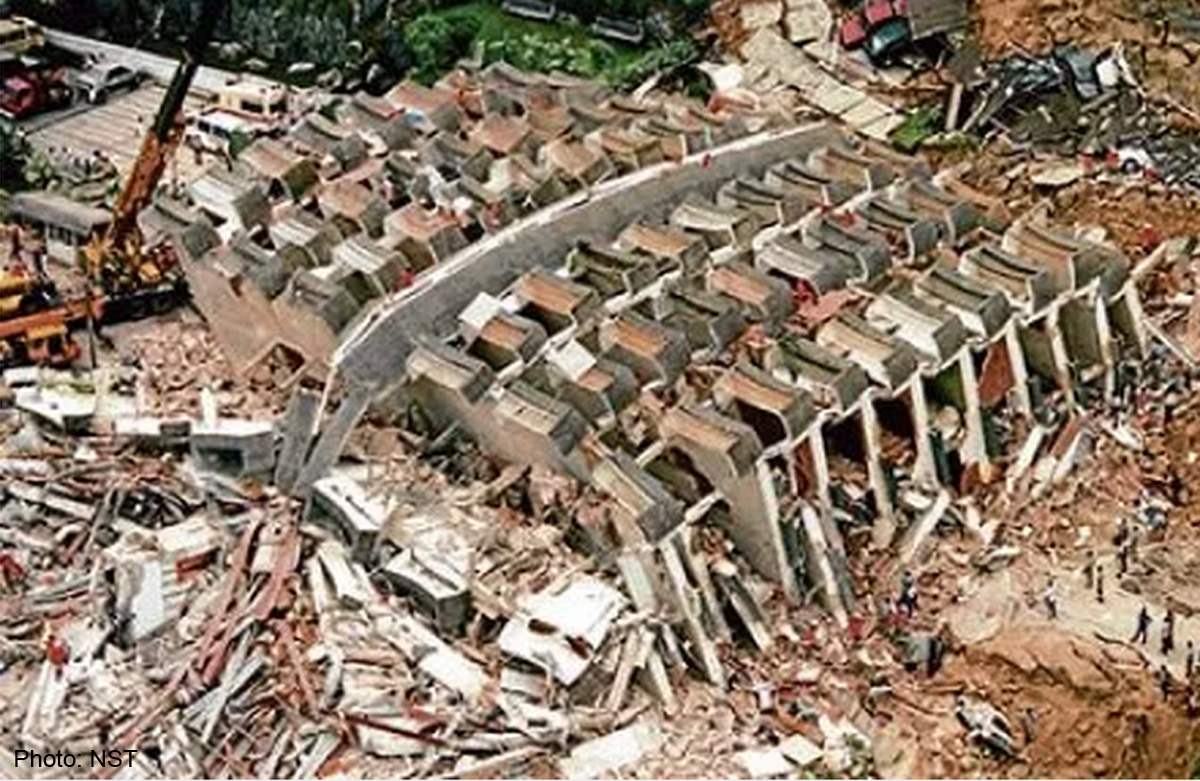
The investigation revealed 5 primary causes for the collapse:
1. The drainage of the adjacent development
2. Two weeks of continuous rainfall saturated the soil
3. Pools of water created unstable, swamp-like conditions at the base of Block 1
4. Piles supporting the building were not supported laterally
5. An underground limestone cave beneath the development collapsed, creating soil instability
An extensive lawsuit led to a RM 52 Million ($15.4 Mil USD) settlement; the engineer and architects’ names were withheld from the public. Some special considerations that may have prevented this tragedy. Retaining walls should be able to resist overturning even with the additional pressure generated by a landslide or any similar event. Additionally, the climate and erosion were not taken into effect. Additional planning for areas receiving so much rainfall, and the possible erosion accompanying it, has the potential to save lives.
Photo links:
http://photos.wikimapia.org/p/00/01/67/40/85_big.jpg
https://terrifictop10.files.wordpress.com/2014/01/highland-towers.jpg
https://buildingfailures.files.wordpress.com/2014/02/shanghaicondo_02.jpg

No comments:
Post a Comment